As a
twelve-year old in 2008, I was obviously a huge fan of the Twilight. Not
only did I read all the books and watch all the movies, I even bought Twilight
in Spanish while in Cancun because I thought I could read it for some reason.
While I quickly started detesting the series because the movie came out on my
birthday and people began to refer to my birthday as the same day Twilight
came out rather than the other way around (and yes I am still salty about that)
amongst other issues I could go on for- there is no doubt that it was still one
of the first young adult series I read and therefore, it is special to me in its
own way and there can be no doubt it revived a love of vampires and soon
werewolves as well. These vampires, however, were different from the vampires
in Dracula.
Edward, the
main love interest for the protagonist Bella, is often made fun of and called
gay by audiences not because he is (although one certainly could try and do a
queer reading between him and Jacob, Bella’s other love interest), partially
because of the masculinity he chooses to perform and also because he is an over
100 year old virgin who turns down Bella’s offer to have sex on multiple occasions.
While Bella, the woman’s, sexuality is somewhat discussed and arguably not
repressed, Edward’s is more feminine in the sense that he wants to wait until
they are married and is possibly more repressed- the opposite of the male and
female characters in Dracula.
Another
feature in Dracula is the New Woman/ Angel in the House dichotomy. Rather
than have a similar dichotomy focused on femininity, there is one that starts
to come out focused more on masculinity through Bella’s two love interests,
Edward and Jacob.
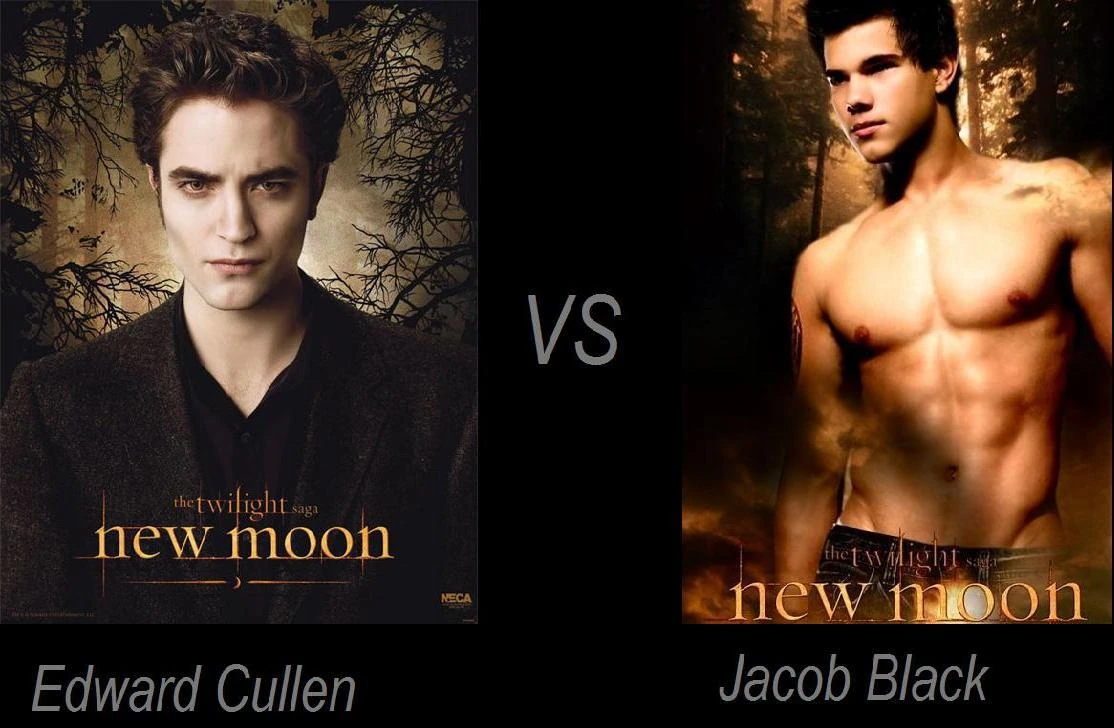
The 100
year old metro sexual Edward with his purposefully messy hair, pea coat wearing,
Volvo driving ass is the complete opposite of Jacob who is young, muscular,
more animalistic as he is a werewolf, and who works on the motorcycle he later
rides. These two masculinities are competing not only for dominance, but for
Bella’s love. While in Dracula there is discord because of the coming of
the New Woman’s femininity, there is discord in Twilight from the “new
man’s” metro sexual tendencies which ultimately win over Bella through Edward
over Jacob’s rougher, outdoorsy, arguably more traditional/older masculinity.
 |
| Look at those competing masculinities |
One final comparison
is that of foreign invasion. While in Dracula, Dracula himself can
represent fear of immigration, the Volturi could represent this as well as a
general fear of change in Twilight. The Volturi are an old vampire clan
who are in control of basically all vampires and are ancient in both age and
custom. They end up being the final, main antagonists in the series who want
Bella and Edward’s new half-breed daughter dead and come to America to go up
against Edward’s all-American, baseball playing family. The differences between
the two families/clans are both in age and culture- that of an ancient European
one in the Volturi and that of a younger, American culture in Edward’s family
who ultimately wins out over the Volturi.
 |
| The modern American Cullen family (Edward and Bella not pictured) versus the ancient, foreign Volturi |
Between Dracula
and Twilight, there are certain elements that remain like fear of
foreign invasion, but others like sexuality and a masculine dichotomy, that focus
more on men than women.