Wednesday, April 6, 2016

Dracula as a Metaphor for Addiction

Dracula can be seen as analogous to drug addiction, well after all he is “addicted” to blood. 


Addiction had only been recently diagnosed as a physical condition during the 19th century in Great Britain. In the early and mid-Victorian period it was possible for anyone to just walk in and get laudanum, opium, and even cocaine without any kind of prescription. The most popular opium derivative was laudanum, which is opium mixed with alcohol. Laudanum was called the “aspirin of the nineteenth century” due to it widely being used as painkiller, and it was recommended for a broad range of ailments such as cough, diarrhea, and was frequently used among the women population for “women’s troubles”. It is no surprise that the people during this time period were getting addicted to a drug that they used on the daily, like how nowadays Tylenol and aspirin is used.


So relating back to vampires, they may not want to feed on human blood but they are compelled to do so, similar to how drug addiction works. Most people do not need to shoot up various drugs, but they feel like they have to do since they become addicted to these hard drugs. Considering Stoker’s interest in keeping everything about Dracula very up-to-date, it seems pretty plausible that Stoker is trying to make vampirism be symbolic for addiction.

As it has been demonstrated many times over, drug addiction can be seen as a force that can take control of the lives of users, and completely turn your world upside down. Dracula’s powers can be witnessed in a number of different ways. He is a shape-shifter who has the ability to command the loyalty of those under his spell, and who can control anyone who he encounters. Once Dracula marks his prey, he promises to change the life of all he consumes, leaving the victim thinking about nothing but Dracula himself. Hmmm…. Sounds like drug addiction doesn’t it?


 Drug addicts can be so drawn to their need for a drug that it can be all consuming and take over their life, similar as to how Dracula has a hold on his victims. A specific example from Dracula is when Mina experiences Dracula’s allure, unable to withstand or ignore his power. This same power already has been seen to have drawn Miss Lucy (Mina’s closest friend) to the dark side. In the move interpretation of Dracula, Mina is aware that the count represents a threat, but she still wishes to be with him always and ignores her friends who warn her to beware. Mina is so enamored of his charms that she cannot resists Dracula’s seduction and sensuous personality. This can be compared to how drug addiction can draw people towards a drug making them weak and making resistance harder and harder. Another example is Dracula’s lack of reflection in the mirror, which is similar to how drug addiction can lead to an empty promise of seeing the true self while others who witness Dracula in front of a mirror see nothing. There are many parallels seen showing how Dracula can be seen as a metaphor for addiction. It is even somewhat pitiful how vampires are forced into having extreme addiction that they cannot escape from, besides by death.


Marceline the Modern Vampire Queen

Thanks to the popularity of Bram Stoker's Dracula, we now have a myriad of inspired and unique modern vampire characters to choose from in all sorts of genres.

You have Alucard, the fuck-mothering Vampire in horror, Edward Cullen, a.k.a. "Mister Bad Boyfriend slash Poor Role Model for Boyfriend" in romance, and somewhere in the middle is that one vampire Johnny Depp played in "Dark Shadows" for drama.

And then you have Marceline the Vampire Queen.

black and white adventure time marceline
Nothing to see here, folks. Just Marceline being chill in her debut episode.

Marceline is as her name implies: the queen of vampires. She is radical, musically talented, unbound, wily, powerful, and, as of a recent miniseries, has become a complex and deeply developed character.

Not something you can say often about a cartoon character, let alone one from Adventure Time.

Her introduction into the cartoon was a commandeering of the tree-house home of the main characters Finn and Jake, which can be seen as a parallel to Dracula's invasion of London, England, albeit with less bloodshed and more musical numbers.

Marceline can transform into a wolf, a bat, change her size and shape, make herself invisible, and is able to suck blood. She just prefers to eat shades of red. Ain't that refreshing?
Her powers are the same as Dracula's, as seen above, but with added soul-sucking powers thanks to her demon father, Hundson Abadeer. As a way to make her more G-rated for the show, she is changed from a blood drinker to a red-color drinker. In other words, she can eat shades of red for nutrition.

You know, for kids!

Marceline also shares a common feature with Dracula involving sexual tension and homosexual undertones. Although, while Dracula has more of a male homosexual nature defining his character, Marceline has a female homosexual tension between her and Princess Bubblegum. This was heavily speculated before the two were even in the same episodes, and it wasn't until a certain Comic Con that Pendleton Ward, the creator of Adventure Time, admitted there was some "history" to the two royals.

adventure time singing marceline princess bubblegum
I will admit, they do look nice together. And recent episodes do add into this . . . 
Marceline's episodes are also laden with sexual innuendo, or seem to have some sort of sexual content that is absent from most Adventure Time episodes. In "Henchman", Marceline had a line where she asked Finn whether a man's tie looked like a woman's bra or not. She also lets another line of innuendo loose in the episode "Go With Me" when Finn asks her to the movies. She says "Fine . . . but no tongue", much to the preteen's shock and disgust.

The content goes on from there, including some rather interesting lines from her in the episode "What Was Missing" regarding how she wanted to "drink the red from (Bubblegum's) pretty pink face". This also falls underneath the homosexual undertones of her character, but is far more overt than Dracula's claiming of Jonathan to the vampiresses.

Why Marceline is a conduit for the show's more sexual tones is unknown to me. Is it because of her age and her vampiric nature? Is it because of her physical appearance and voice? Is it a teenage thing, or is an attractive monster thing?

And then there's this: how can I call Marceline a complex character when all I have covered is her being a vampire with a sexual identity?

I can answer that with this.

love sad adventure time cartoon network marceline
This is when fans of the show know to get the tissues ready. 

What separates Marceline from other vampires in fiction, aside from being in a cartoon, is her strong characterization and backstory. The show takes great strides in her depth and development, as recently proven with the eight-episode miniseries of her losing her vampirism and regaining her humanity.

The episodes do a wonderful job of giving Marceline a proper backstory and amazing origins. She was once a precocious kid, cared for by her mom, and was the daughter of a demonic being. She was taken in by a man who was succumbing to madness from an inanimate object, and her best memories are the ones she considers to be filled with people she cared about.

Her favorite thing: a stuffed toy, a monkey doll named Hambo, given to her by the same man who helped her.

This is when you realize the man here is the Ice King, and that I Remember You was about Marceline and Simon Petrikov/Ice King rekindling their friendship.

Her struggle: getting her powers back and saving the Land of Ooo from the King of Vampires and the tarot-themed villains that were released when she renounced her vampiric powers.

Her development: realizing that she was who she was, and that she had matured as a human and a person.

This makes Marceline the Vampire Queen a strong character, and an even better example of avampire done right in modern writing.

. . . Wait, why are you still reading?


Is Dracula a Bad Father?


 Dracula is known for many things like drinking blood, living in a giant castle, and looking like Gary Oldman but did you know he had a son? Not in the Freudian way either, in some reimaged versions of Stoker’s novel Dracula has a son named Alucard (Dracula backwards). Although this character was created for the 1943 movie Son of Dracula Alucard is probably best known for his depiction in the video game series Castlevania. Now you may be thinking that they must work together, but nope, Alucard wishes to impale his father’s head on a stake with little remorse. So what caused the animosity, the cold-blooded hatred between father and son? Simple: mommy issues.

In the series, Alucard is the son of Dracula, the antagonist of the Castlevania series. Due to his human mother, Lisa, Alucard is a dhampir, a half-human, and half-vampire with all the powers of his father, but with none of the weaknesses. His birth name was Adrian Fahrenheit Ţepeş, but Alucard forewent his name after the death of his mother for being persecuted as a witch.  Despite this, Lisa admonished Alucard to respect humans and not hate them as his father did. This caused Alucard to focus his grieving pain into hatred towards his father, who he ultimately blames for not protecting his mother. However Dracula also grieved over the death of his beloved, by trying to resurrect her only to fail, turning her into a succubus then killing her again and by destroying half of Eastern Europe with his army of darkness. For centuries father and son dueled to quench their grieving hatred towards one another.


This may sound like a classic case of Oedipus complex, but I don’t think it is that simple. Lisa’s last words to her son before she was burned at the stake were “Do not take that anger out on the humans, as their lives are already full of hardship” (Castlevania Symphony of the Night). Watching your mother burn to death in front of you and telling you not to blame the people who are currently burning her might scar any child, especially the child of the Prince of Darkness. I believe that Alucard’s hatred towards his father stems from the fact he thinks his father could have saved his mother. Growing up with the equivalent of a demonic superhero as a father Alucard harbored discontent for his father for not protecting his mother from harm, therefore focusing all of his hatred of those who actually killed his mother towards his only living family, his father.     

Dracula and Mina, sittin' in a tree, K-I-S-S-I-N-G

What's the deal with changing motivations in movie adaptations of books? In the 2007 Beowulf film, Angelina Jolie's Grendel's Mother is motivated by child support (by way of fornicating with Hrothgar) while in the epic poem, Grendel's Mother has no hint of sexuality whatsoever. Such is the case with Mina in Bram Stoker's Dracula. In the book, she's portrayed as the Angel of the House in her Victorian day. In the 1992 film adaptation of the book, she's Dracula's reincarnated/lost princess for who he saves his true love. It’s definitely weird, but it works, I guess. The whole movie was very uncomfortably creepy. The love interest plot feels very predictable. At least, when Dracula was pursuing Mina in the film, he was in his younger, more handsome form. That didn’t stop me from imagining him in his old man form (the way he had been portrayed in the film up until that point) and it was significantly creepier. It’s not like I don’t understand the reason why the filmmakers chose to add this plot point to the movie, but that doesn’t inspire me to appreciate it any more. Sex always sells, it always has, it always will, and especially when an attractive, young, pure woman is involved. This film has twice as much sex as it needs. Lucy’s New Woman character arc was preserved and she is shown plenty of times in scantily clad outfits moaning and writhing in the presence of men and monsters. Nearly every time she’s on camera, she’s a symbol for some kind of sex. This movie fails the Bechdel test spectacularly. Lucy’s motivations didn’t require altering because she already had plenty of moments to be sexy. Mina, on the other hand, was going to need a bit more help. Enter the love and affection of Mr. Dracula. A part of me was hoping Mina wouldn’t fall for it, like when she plays hard to get after Dracula’s initial advances. Another positive of the modification compared to the one that takes place in 2007 Beowulf is that it fits somewhat. The Beowulf twist is so bizarre and out of place. The reincarnation of Mina is way more believable than a Grendel’s Mother who wears heels and seduces old men. Nevertheless, I wish the film had stayed truer to the original text and left love out of it. It doesn’t need it, and it’s better off without it.

Mina Harker: Dracula's Bride?

Throughout Dracula, one character remains a constant. That would be Mina Murry Harker, wife of Jonathan Harker and final near victim of Dracula’s spree of evil. In the book and most portrayals, Mina is a school teacher, and only connected to the events by friendship or her husband. Yet when Dracula forces her to drink his blood and start to change, she takes center stage, locates and guides the men to him, all the while remaining determined to help in any way she can to get vengeance for Lucy and put Dracula down for good. Most adaptations of the story stick to this basic framework, with some, such as F.W. Mearneau’s Nosferatu having her be the one to ultimately end Dracula’s reign of terror by sacrificing herself to lure the count into sunlight, and others, such as Alan Moore’s The League of Extraordinary Gentlemen, have her getting into adventures after Dracula’s death, either with or without Jonathan, and generally just being cool. In my opinion, these versions of Mina are solid role models for girls, despite some of the sexist leanings some of the stories have, due to Mina’s overall noble and kind nature, yet having an iron resolve that allows her to journey into battle with a villain who, let’s be honest, raped her, and stand against forces that any human would be terrified to face, and still feel some measure of sympathy toward someone who is pure evil. So why is it that, in most modern versions of the story, Mina is made into a reincarnation of Dracula’s wife and falls in love with him, or just plain out falls in love with him? I seriously don’t get the appeal of this, especially since most times I’ve seen it, it is done extremely poorly. Seriously, the Coppola film might be one of the earliest versions where this happened, but I’ve seen it so many other times that it is ridiculous. In the NBC Dracula series, this was basically the main plot, the “sequel” Dracula the Un-dead by Bram Stoker’s great-grandnephew Dacre has Quincy Harker’s father turn out to have been Dracula along with Dracula actually turning out be a good guy hunting a vampire Elizabeth Bathory, and even the animated film The Batman vs. Dracula has the female lead turn out to be a reincarnation of Dracula’s wife. I have to question why this is so popular. Reading the text, there is only one moment that indicates an actual connection between the two that doesn’t come off as disturbing or rapey. It’s when Mina says she feels sorry for Dracula for his curse, which she follows up by saying that she feels sorry for him just because of how much being a vampire must suck. Considering we don’t know how Dracula was turned in the first place, Mina’s sympathy could be completely misplaced, and Dracula could just be evil. But even still, that one moment doesn’t explain the obsession with putting the two together. The moments that go against that scene include Dracula raping and murdering Lucy, torturing Jonathan, killing untold numbers of people over the centuries, killing babies, beating women, pretty much raping Mina, and a number of other crimes. Yet, somehow, this one scene seems to have become the source for making the two a dedicated couple, despite the only physical interaction between the two being a rape scene. Like I previously questioned, what is with the desire to make us sympathize with character’s that are pure evil? It ruins the mystique around them, and makes them into less compelling characters for me.

The Foreign Invasion: Friend or Foe?

            Racism and xenophobia: two things plaguing our world today that keeps us from seeing eye to eye. To say that these are “hot” topics in today’s world would be an understatement; issues having to do with “foreigners” are one of the biggest issues in our modern world. It isn’t recent issue however; racism and xenophobia have been consistent problems all throughout history. So then, it shouldn’t come as a surprise to find out that it is one of the underlying themes in Dracula.

            The most obvious evidence for this claim is the man himself, Dracula: a foreigner who speaks imperfect English with a heavy accent, coming to a different country and immediately causing trouble. This entire idea parallels the thought process of people of Great Britain at this time. This comes, at least in some way, from the decline of British Imperialism. For the longest time Great Britain had conquered and oppressed country after country and when they finally calmed down, many people were worried(scared more like) that some of those people would be a bit ticked off. Many were taking note of the rise of other economies, such as Germany and the United States, and the growing unrest in British colonies and took it as a sign that Britain was in a decline-economically, politically, socially and so on (Arata 622). This rise and their fall caused many citizens to grow afraid of foreigners as they were on the rise and might want payback for Britain’s misdeeds.


            So then, Dracula represents an invasion of sorts into the British way of life. Dracula shows up and (though a small group) life starts becoming chaotic. Lives are lost, routine is interrupted and so on. But Dracula only represents one side of the foreign invasion. Consider Quincey Morris, the Texan who is not only one of Lucy’s love interests, but also one of the “heroes” of the story. Everyone seems fine with him, but he is a foreigner so what’s up with that? Well there’s a few reasons for this. First of all, by this time America and Britain were allies. Tensions were not nearly as high as they had been in the past, so the fear of Americans wasn’t very high. However he is portrayed differently from the Brits. Quincey, while not being portrayed as dumb per say, isn’t portrayed as the smartest man. In fact, in terms of story, he doesn’t provide much. A blood transfusion, some dialogue here and there, and help in destroying the boxes, he isn’t exactly the most important character…until the end. In the final fight with Dracula, Quincey is one of the main contributors in the fight against him, and also the only casualty on the “good” side. In one fell swoop, both foreigners, Dracula and Morris, are killed. I believe this is a way for Britain to “assert” its rapidly declining power, having the British characters survive while the foreign, friend and foe, perish. Whether or not it actually signifies that exactly, the similarities and differences between Morris and Dracula are interesting.


Here is my source by the way: http://www.jstor.org/stable/3827794?seq=2#page_scan_tab_contents

Because someone had to mention Twilight..

            As a twelve-year old in 2008, I was obviously a huge fan of the Twilight. Not only did I read all the books and watch all the movies, I even bought Twilight in Spanish while in Cancun because I thought I could read it for some reason. While I quickly started detesting the series because the movie came out on my birthday and people began to refer to my birthday as the same day Twilight came out rather than the other way around (and yes I am still salty about that) amongst other issues I could go on for- there is no doubt that it was still one of the first young adult series I read and therefore, it is special to me in its own way and there can be no doubt it revived a love of vampires and soon werewolves as well. These vampires, however, were different from the vampires in Dracula.
            Edward, the main love interest for the protagonist Bella, is often made fun of and called gay by audiences not because he is (although one certainly could try and do a queer reading between him and Jacob, Bella’s other love interest), partially because of the masculinity he chooses to perform and also because he is an over 100 year old virgin who turns down Bella’s offer to have sex on multiple occasions. While Bella, the woman’s, sexuality is somewhat discussed and arguably not repressed, Edward’s is more feminine in the sense that he wants to wait until they are married and is possibly more repressed- the opposite of the male and female characters in Dracula.
            Another feature in Dracula is the New Woman/ Angel in the House dichotomy. Rather than have a similar dichotomy focused on femininity, there is one that starts to come out focused more on masculinity through Bella’s two love interests, Edward and Jacob.
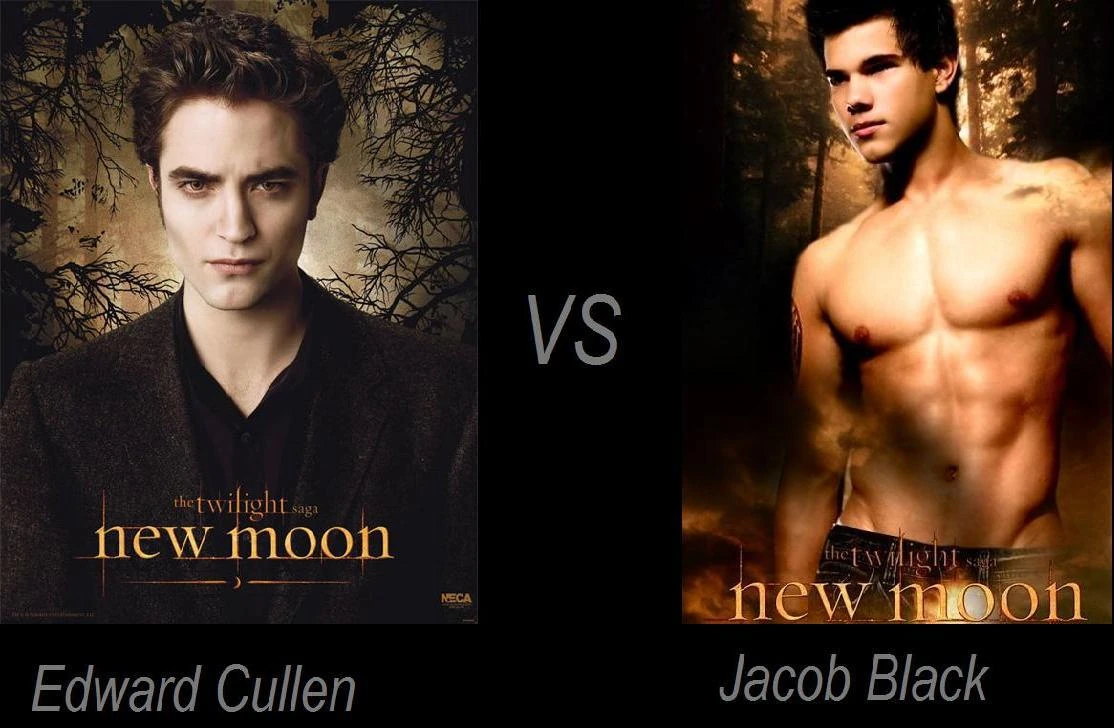
            The 100 year old metro sexual Edward with his purposefully messy hair, pea coat wearing, Volvo driving ass is the complete opposite of Jacob who is young, muscular, more animalistic as he is a werewolf, and who works on the motorcycle he later rides. These two masculinities are competing not only for dominance, but for Bella’s love. While in Dracula there is discord because of the coming of the New Woman’s femininity, there is discord in Twilight from the “new man’s” metro sexual tendencies which ultimately win over Bella through Edward over Jacob’s rougher, outdoorsy, arguably more traditional/older masculinity.

Look at those competing masculinities 
            One final comparison is that of foreign invasion. While in Dracula, Dracula himself can represent fear of immigration, the Volturi could represent this as well as a general fear of change in Twilight. The Volturi are an old vampire clan who are in control of basically all vampires and are ancient in both age and custom. They end up being the final, main antagonists in the series who want Bella and Edward’s new half-breed daughter dead and come to America to go up against Edward’s all-American, baseball playing family. The differences between the two families/clans are both in age and culture- that of an ancient European one in the Volturi and that of a younger, American culture in Edward’s family who ultimately wins out over the Volturi.
The modern American Cullen family (Edward and Bella not pictured) versus the ancient, foreign Volturi


            Between Dracula and Twilight, there are certain elements that remain like fear of foreign invasion, but others like sexuality and a masculine dichotomy, that focus more on men than women.